Seen Into Being
Being formed as the "Observed"

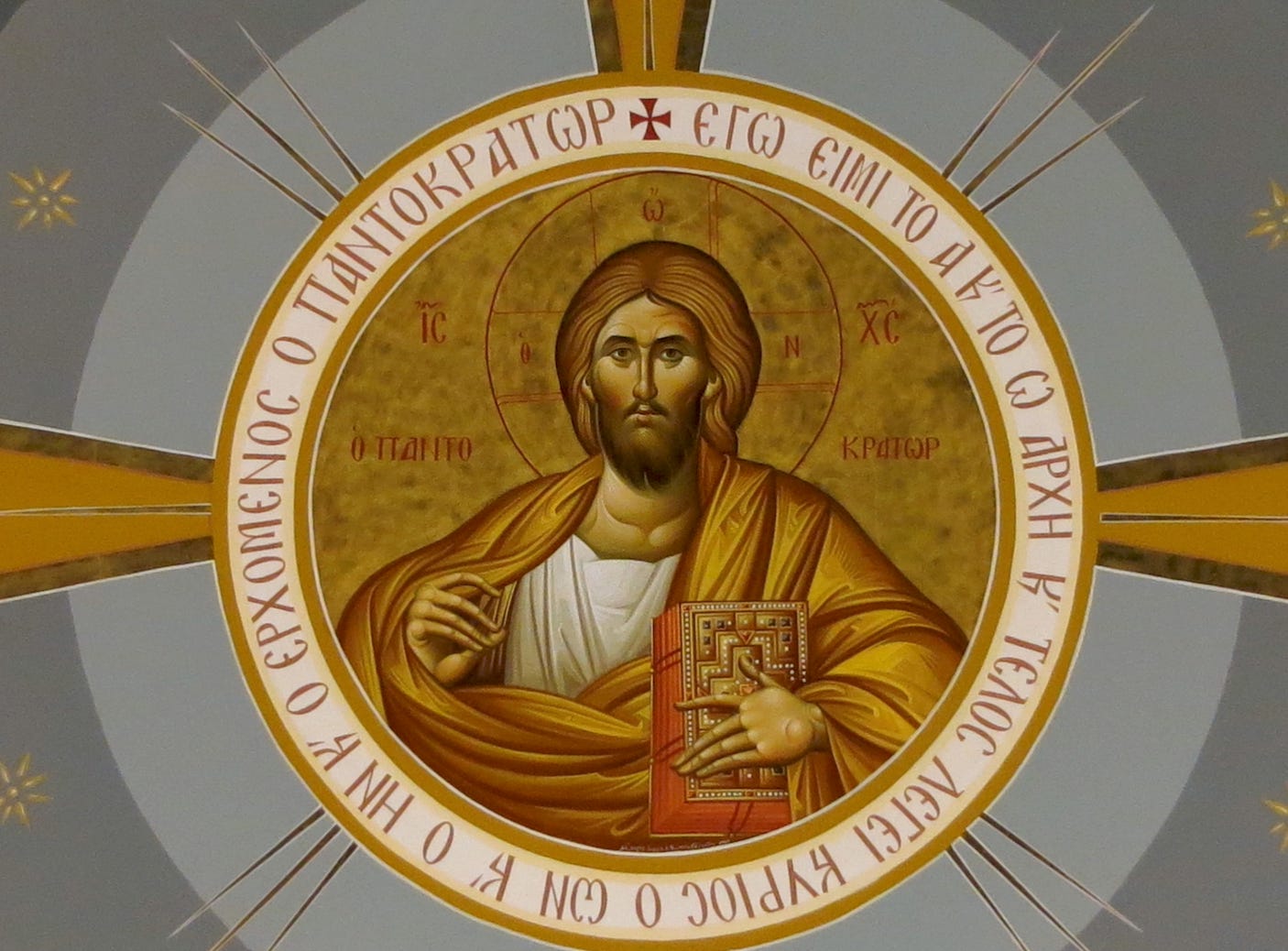
There is something about the eyes of an icon.
They are uncomfortable at first. You might enter an Eastern Orthodox church, or even a community that appreciates and is shaped by her traditions (e.g., like Pastor and author Brian Zahnd’s Word of Life Church in St. Joseph, Missouri), and it takes a minute for your eyes and heart to adjust. Icons do not make a sound, but they can send reverberations, cause questions, and even concerns.
They stare, and they wait for a response.
Whether it be the icon of the Pantocrator (i.e., Christ the King or Christ the Sustainer) keeping watch as you partake of the Eucharist under the intrados, or the soft, humble, and empathetic gaze of St. Nektarios, icons are not overly dramatic. They are not sentimental. They are just present.
And it’s in their eyes.
You expect that you might look at these images the way you look at everything else. That is what we are trained to do, after all. Glance, quickly assess, maybe appreciate, and move on to the next image; preferably one that is moving, bright, and adrenaline-producing.
But that is not what happens.
You have the odd sense (and it may be subtle at first) that you are not just looking. It is you who is being observed.
You move a little, and the gaze doesn’t shift.
And for a brief moment, you no longer feel as though you are just a person moving through a building, observing art.
You are a person (a thou) standing before someone who sees you.
We don’t have many experiences like this anymore; experiences of being beheld. We spend most of our days looking at things. And even when we do so, we are guilty of commodifying most of them.
Phones, screens, news, videos; the endless streams of images have our constant and much-divided attention. From the moment our eyes open to engage the world in the morning until the time (often far too late) that they slowly give up on the final YouTube video and give in to the fatigue caused by constant stimulation, our eyes are occupied.
However, almost none of what we look at looks back, engages us, or challenges us. Instead, it robotically reacts by calculating and learning our preferences so that it might feed us more of what we are likely to click on. This commodification of the visual consumer is not the same as being seen. It is closer to being tracked. It is the difference between being known and being analyzed.
We are forever in search of a story to define us, or at least entertain us, and we believe that the more we observe, the more likely we are to find one.
The Gospel narrative starts from the opposite perspective. It begins with human beings as those who are seen.
Before anything else (before work, before responsibility, before action), there is God, and there is His attention. It is why an apocalyptic imagination is so important! A continual breathing in and out of the reality that God is closer and the story is bigger than we think it is.
This was Hagar’s understanding when, in her despair and deserted state, she literally names God “El Roi”; i.e., “the God who sees” (Gen. 16:13).
To be seen by God is not to be glanced at with an indifferent affect, or for entertainment purposes (although we must be pretty comical at times). It is to be known. And to be known is to exist in a way that makes us “thous,” not “its” (Martin Buber).
The Psalmist says the same thing in a different way: “You have searched me… you know me” (Psalm 139:1).
This means that there is nowhere to escape the omniscient stare; the all-knowing, yet fully compassionate gaze of the enthroned Christ. And this tells us that being human is not first about what we see. It is about the fact that we are seen, and Who sees us.
That is part of what feels “off” about the world we currently occupy.
It is easy to accept that we see more than any previous generation. But we are rarely addressed fully. Rarely known fully. Rarely placed within a larger narrative of “known-ness.”
We are always peering ahead for a story. Everything behind us has been dismissed by modernity’s declaration that the past has cataracts and offers nothing of use to the present. There is no unifying Sacred Canopy (Berger) above us to speak over us and infuse a sense of seen-ness.
We have become very good at looking, as long as it is at the fleeting present or the near future; but not behind or above, where we might witness wisdom’s stare or heaven’s “glorious streams.”
We are not as good at standing before something to be observed, recognised, and (heaven forbid) overtaken by an epic!
This is where something like an icon quietly pushes back. Icons are not loud or aggressive. They silently and solemnly look back at us.
An icon doesn’t behave like the rest of the visual world, in that it doesn’t seem interested in trying to impress or entertain you. It doesn’t give you much to “do” with it.
It just remains.
However, if you remain long enough, you will start to notice that it is anything but passive.
Especially the eyes.
They meet you and… (this is unsettling) follow you.
Wherever you stand, they are there.
Reminding us of the words of the Psalmist…
“Where can I go from your Spirit?”
Where can I flee from your presence?
If I go up to the heavens, you are there;
if I make my bed in the depths, you are there.”
Psalm 139:7–8
To be clear, I am not Eastern Orthodox; although I have often been accused (especially when I was bearded) of drifting. I’m not suggesting we venerate icons, or that there’s anything mystical in the object itself. I am also aware that the way most evangelicals understand the use of icons in the Eastern Orthodox Church is misunderstood and misguided, and that even if they were to understand, they would still most likely disapprove.
I am not arguing for the use of icons. That is not my point.
The point is simply concerning what this type of encounter might train us to notice.
What an icon does (or the statue of a pious saint, or the sacraments when properly approached) is remind us of something that has always been and will always already be true: we live our lives before the face of God.
Not only when we remember, but always!
The icon cannot create that reality, but it can perhaps wake us up to it.
When we begin to live with the awareness that we are seen (not in the anxious, covert way Sting’s 1980s subject imagines, but in a way that means we are truly known and loved), we begin to carry ourselves differently.
There is an invitation to a quiet alignment with what is true of us because we are seen.
We are not attempting to construct ourselves from scratch anymore.
We are responding.
Church spaces have traditionally tried to do something similar, just on a larger scale.
In the great cathedrals of Europe, and prior to the church becoming theatre in much of the modern West, there is no need to explain what is happening. The atmosphera sacra does the work for us, as the height and the light draw our attention upward. It tells us, without saying it outright, that we are not the centre of everything. And beautifully, and perhaps surprisingly, in the midst of modernity’s millions of mini-me cathedrals, it’s relieving.
Because if we are not the centre, then we are not carrying the weight of holding everything together either. The “burden of self” (Ehrenberg) is not on us.
We are placed and located within the vision of God.
Are we shaped as constant observers, or as the constantly observed?
If we are shaped solely as observers, we will be trained to look constantly without ever being known, move quickly without ever being settled, and to consume without ever being addressed.
As the observed, we are invited (implored even) to slow down and to be placed. Fixed and fixated upon.
To be observed reminds us that we are seen and, hopefully, over time, that seen-ness will shape and form something in us.
A lot of what we call anxiety or restlessness today is not just internal. It has something to do with the environments we live in. It is the outcome of a continued and relentless experience of being unknown in any deep sense.
Experiencing a reality of unseen-ness is no small thing.
Do I matter? Am I known?
To stand before Christ (whether in prayer, in Scripture, or even observing the Pantocrator and sensing that you are being observed more than the icon) is to entertain a reality where that question is answered.
With a presence.
You are seen. You are known. You are loved.
And that gaze (steady, unhurried) does the very opposite of diminishing you.
It welcomes and expands your story.
The Pantocrator specifically does not invite you to ask, What am I looking at?
It is to ask, Whose gaze and story am I living under?
What sort of gaze is forming me?
The modern world gives us plenty to see, all the while ignoring us.
Christ the Sustainer need not offer you more content, for “It is finished,” but you will always garner His attention.
And it is in being seen that we begin, slowly, to understand who we are.
Thank you, Brad! "You are seen. You are known. You are loved. And that gaze (steady, unhurried) does the very opposite of diminishing you. It welcomes and expands your story." ... I always felt for some reason that being known was safe but being seen was alarming. Acceptance vs assessment. Yet the love displayed on the cross changes everything and that's why my story expands, eh?. So good.